
For Universities
The student journey deserves more than a dashboard
ProjectU is a student-built, peer-supported learning experience for the space between knowing and doing.
We help students navigate pressure, uncertainty, goals, failure, wellbeing, and connection while those things are actually happening in their lives.
53%
Report High Stress
High stress is not occasional. For more than half of students, it is part of the university experience.
60%
EXPERIENCE SOME DEGREE OF LONELINESS
Being surrounded by people does not guarantee connection. Three in five students report experiencing loneliness.
41%
Experience frequent performance pressure
For two in five students, pressure to perform is recurring, shaping how they study, make decisions, and experience university.
56%
Report STUDY-RELATED EMOTIONAL EXHAUSTION
More than half of HBO and WO students report emotional exhaustion related to their studies.
RIVM & Trimbos Institute, Monitor Mental Health and Substance Use among HBO and WO Students, 2025.
The Student Reality
What the average
journey actually
looks like.
Universities measure outcomes.
GPA, progression, graduation, wellbeing.
But these measures capture moments and outcomes and not the journey between them.
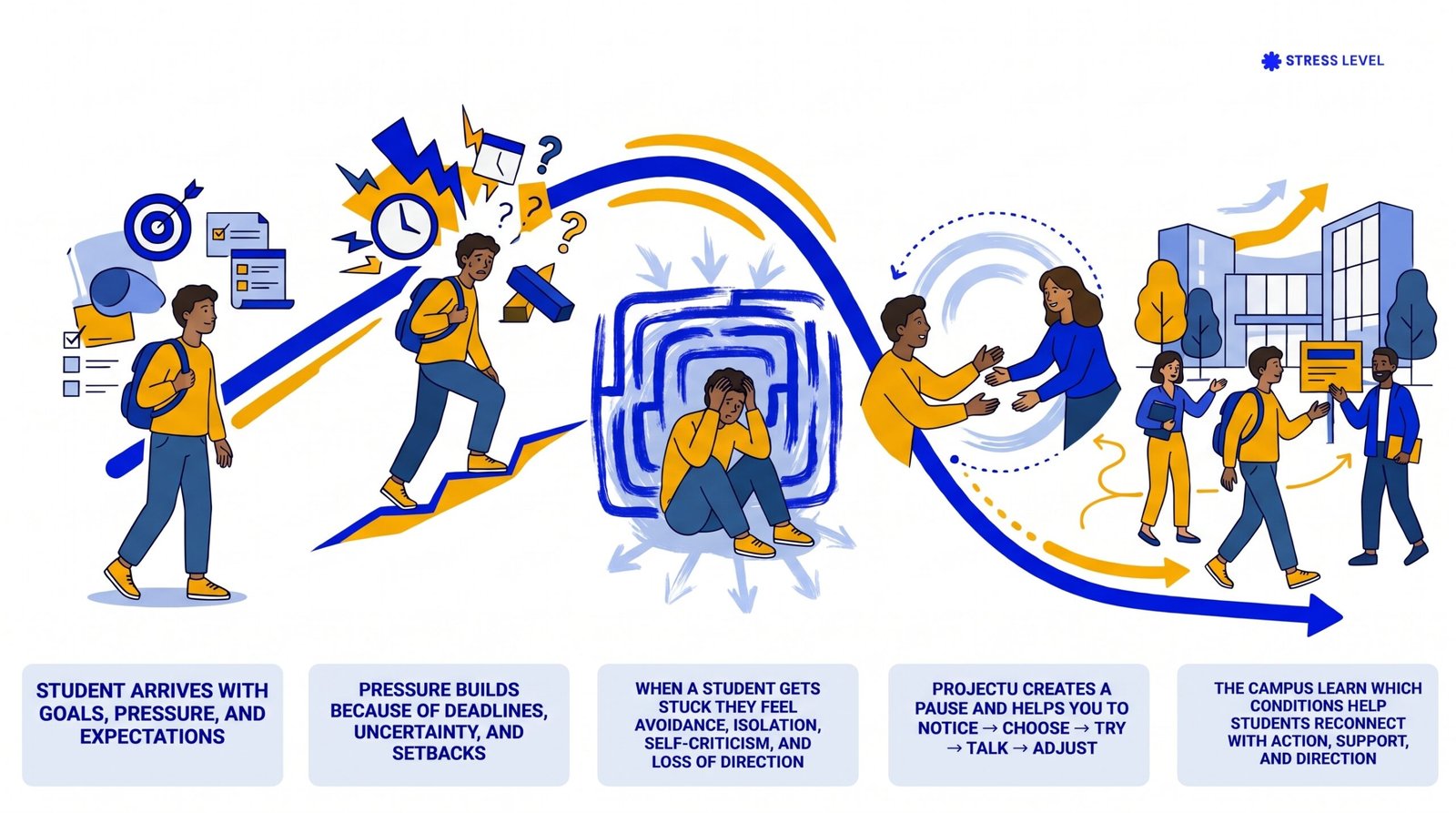
The pressure that builds. The weeks when motivation drops. The moments students get stuck, disconnect, recover, or take action.
That is where the student journey is shaped.
Personal, Small action
Students work on a real pattern in their own life, rather than completing a generic task.
Peer connection with a purpose
Students have a place to speak honestly, reflect, and not carry pressure alone.
Recovery as part of the model
A missed step becomes information: adjust, rest, ask for support, or restart.
Evidence your campus can use
Measure ownership, action, recovery, connection, wellbeing, and pressure before, during, and after the program
The cost of waiting
Student disengagement becomes is a systemic problem.
Student wellbeing is not separate from educational performance. When students struggle to stay engaged, progress, or recover from setbacks, the effects extend beyond the individual -> into study progression, support demand, staff capacity and institutional resources.
Dropout/Non-Completion
~€10K–€25K
estimated financial exposure per student
When a student leaves without completing, the institution loses future tuition and the student's contribution to enrolment- and degree-linked government funding. The exact impact depends on when the student leaves, programme type and remaining study duration.
Study Delay
~€5K-€10k
estimated exposure per additional year
Students beyond nominal study duration no longer count toward funded enrolments, while teaching, administration and student support can continue. The exact net cost varies by institution and student.
Mental-health support demand
66%
of students with mental-health problems received advice or help
32% received support within their institution
through advisers, mentors, psychologists, tutors and deans.
€15M / year national student-wellbeing funding
Allocated annually to Dutch higher education to implement the Student Wellbeing Framework.
The Scale of Delay
70%
have not completed within nominal duration
Only 30% of Dutch bachelor entrants complete within the theoretical duration. Completion rises to 55% one year later and 73% within three additional years.
The cost is distributed between:
Progression
Retention
Support
Administration
Staff Capacity
THE QUESTION IS NOT WHETHER DISENGAGEMENT COSTS MONEY. IT IS HOW MUCH CAN BE PREVENTED EARLIER?
The ProjectU Effect
Same students. Different trajectory.
ProjectU doesn't select high-performers and make them better. It works with students where friction already happens: pressure, avoidance, overthinking, isolation and difficulty following through, and gives them a structure to act, reflect and adapt before those patterns become harder to change.
Pressure -> Response
Gets stuck in avoidance
Notices the pattern + Acts
The struggle does not magically disappear. Students learn to recognise what happens under pressure, choose a small next action and review what happened.
Motivation -> Structure
Relies on motivation to execute
Builds habits and identity
Motivation fluctuates. Students turn intentions into concrete actions, routines and environmental cues that make follow-through easier.
Alone -> Accountable
Struggles alone
has a peer who follows up
Every participant is paired. Progress becomes visible through check-ins, reflection and peer accountability.
Formal -> Accessible
Support can feel distant
Peer-led + Embedded in student life
ProjectU creates a lower-threshold space where students can talk honestly, reflect and take action, without turning every struggle into a clinical problem.
Reactive -> Earlier
support often follows the problem
capacity is built earlier
ProjectU works upstream: students practise navigating pressure, setbacks and uncertainty before problems require more intensive support.
Attendance -> Engagement
peer programmes can lose participants
100% Pilot completion
Every participant in ProjectU Pilot 1 completed the full five-session programme which is an early signal that the format can sustain engagement.